

9 Security Operations Centre Best Practices for Efficiency and Cost Savings
Post on
November 10, 2025 •
By
TrackTik
Key Takeaways:
A modern SOC cuts costs and improves response times by replacing fragmented, manual processes with a unified platform that automates workflows, surfaces real-time data, and empowers security guards to act on accurate information—not guesswork.
The 9 practices at a glance:
- Centralize operations on a unified SOC platform — eliminate data silos, cut response lag
- Integrate AI to reduce alert fatigue — reclaim up to 25% of operator time lost to non-actionable alerts
- Shift to cloud-native security — enable cross-site visibility and scale without hardware overhead
- Embrace proactive detection — cut breach containment time by up to 50%
- Automate repetitive tasks — reduce scheduling, reporting, and billing overhead
- Strengthen Identity and Access Management (IAM) — close the insider threat and credential gap
- Optimize resource allocation with data-driven planning — reduce overtime and duplicated coverage
- Track performance metrics and KPIs — turn operational data into budget justification
- Invest in training and engagement — reduce attrition-driven cost and service gaps
Physical security leaders are facing a defining moment. Security budgets declined by 29% in 2025 (TrackTik, 2025), yet the environments they’re asked to protect keep growing in size, complexity, and risk. Manual reporting slows response. Siloed systems hide critical insights. And without unified visibility, organizations can’t confidently answer one of the most fundamental questions in security: Are we truly protected right now?
This guide breaks down nine essential SOC best practices—not as abstract principles, but as actionable frameworks with implementation steps, measurable KPIs, and decision tools your team can apply today.
⚡ Fast Facts: The Cost of an Inefficient SOC
CASE STUDY | Ollivier Managed Security: Unifying Detection and Response
Founded in 1987 and headquartered in Los Angeles, Ollivier Managed Security had long operated with a familiar—and costly—gap: guarding operations ran separately from security technology systems. Dispatch was manual, incident data lived in multiple tools, and response timelines couldn’t be measured end-to-end.
The challenge: Alarms, guard locations, and incident reports existed in separate systems. After an incident, pulling together a complete picture required manually reconciling multiple data sources—delaying accountability and obscuring response quality.
The change: Ollivier integrated TrackTik with Immix (a remote monitoring platform), creating a unified operational flow where alarms, dispatch activity, and security guard locations are all visible in a single interface. An alarm triggers, an operator acts, a security guard is dispatched, and arrival and response are automatically tracked.
The outcome: Measuring incident creation to dispatch, and dispatch to on-time response, is now possible for the first time. Operational efficiencies—like dispatching directly from the command center instead of calling security guards manually—are now trackable, enabling Ollivier to demonstrate value to clients with real data rather than subjective reporting. “Businesses trust us to manage their security program, not just guards, not just systems. The integration with TrackTik and Immix allows us to do that.” — Louis Boulgarides, President & CEO, Ollivier Managed Security (Trackforce, 2026)
SOC Performance: KPI Reference Table
Track these six metrics to diagnose inefficiency, control costs, and demonstrate ROI.
|
KPI |
Plain-language formula |
Target range |
What it tells you |
Cadence |
|
MTTA (Mean Time to Acknowledge) |
Time from alarm trigger to operator acknowledgment ÷ # incidents |
< 2 min (monitored); < 5 min (patrol) |
Alert responsiveness; high MTTA = staffing gaps or alert fatigue |
Daily / per shift |
|
MTTR (Mean Time to Resolve) |
Time from incident creation to closure ÷ # incidents |
< 30 min (low severity); < 10 min (high) |
Resolution efficiency; high MTTR = workflow or comms bottleneck |
Daily / weekly |
|
Patrol Completion Rate |
Completed checkpoints ÷ scheduled checkpoints × 100 |
> 95% |
Coverage reliability; low rate = staffing, routing, or motivation issue |
Per shift / daily |
|
False Alarm Rate |
False alarms ÷ total alarms × 100 |
< 10% (world-class); < 20% (acceptable) |
Triage quality; high rate = alert fatigue risk and wasted response cost |
Weekly / monthly |
|
Overtime % |
OT hours ÷ total scheduled hours × 100 |
< 10%; reforecast if > 15% for 2+ weeks |
Labor cost control; sustained high OT = scheduling or coverage model failure |
Weekly |
|
Incident Closure Rate |
Closed incidents ÷ total opened × 100 (by period) |
> 90% within SLA window |
Operational throughput; low rate = triage backlog or under-resourcing |
Weekly / monthly |
Decision Aids: Formulas and Thresholds for SOC Planning
Guard Coverage Sizing
Required FTEs = (Total patrol hours per week) ÷ (Hours per FTE per week × utilization rate) Example: 280 patrol hrs/wk ÷ (40 hrs × 0.85 utilization) = 8.2 FTEs required. Round up and build in 10% buffer for absenteeism.
Overtime Reforecast Trigger
If OT % exceeds 15% for two consecutive weeks → reforecast headcount. If OT % exceeds 20% in any single week → escalate immediately to operations review. Formula: OT cost impact = OT hours × (hourly rate × 1.5) — compare against cost of adding one part-time FTE.
False Alarm Triage Threshold If false alarm rate > 20% in any two-week period → audit alarm source rules and triage criteria. Escalation rule: Any single source generating > 30% of false alarms within a month should trigger a rule reconfiguration review before the next billing cycle. Cost check: False alarm dispatch cost = (avg. response time per false alarm in hrs) × (hourly all-in guard cost) × (number of false alarms per month).
1. Centralize Operations on a Unified SOC Platform — Your Single Source of Truth
Fragmented systems are a hidden cost center: every silo adds response lag, duplicate data entry, and compliance gaps.
What it is
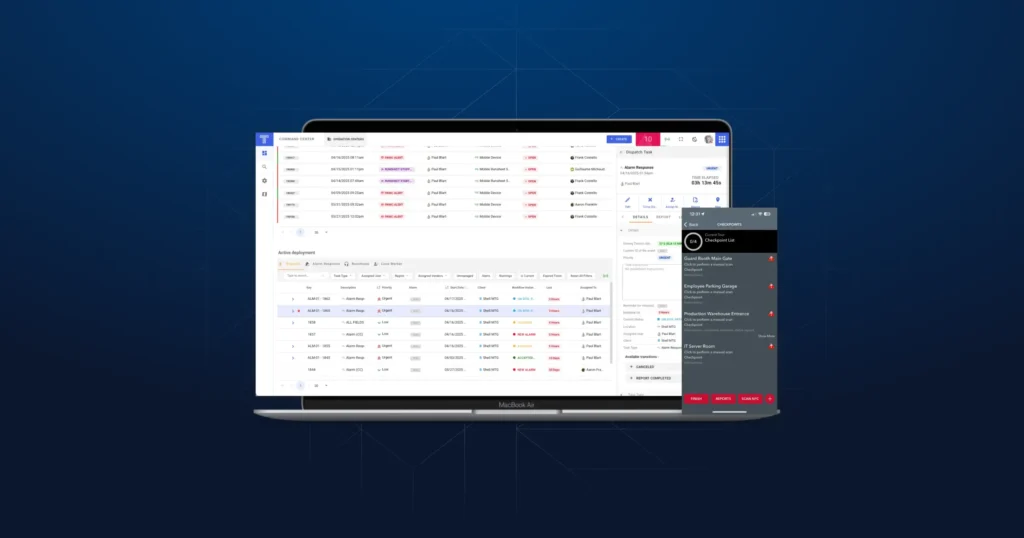
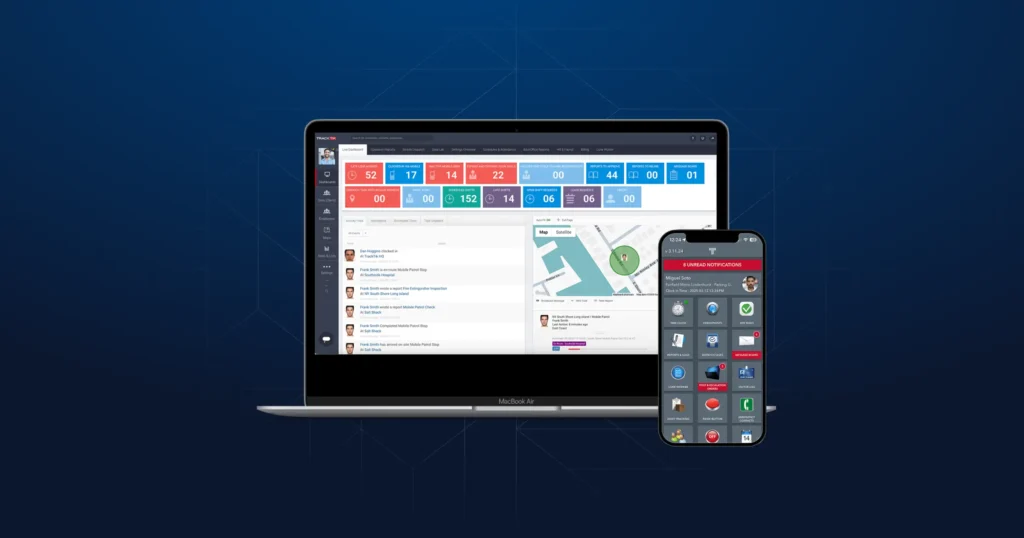
A Security Operations Center (SOC) is the centralized hub from which security operations are monitored, managed, and coordinated. A unified SOC platform consolidates guards, devices, sites, and workflows into one real-time environment—replacing disconnected tools with a single source of operational truth.
Why it matters for efficiency and cost
Disconnected dispatching, manual reporting, and siloed data create measurable cost drag: slow response (driving SLA penalties), duplicated data entry (adding 1–3 hrs/shift of admin overhead per site), and audit failures (escalating compliance costs). Each gap between systems is a gap in accountability—and a gap in your budget.
How to implement
- Audit your current tool stack: list every system guards, dispatchers, and supervisors use. Flag any manual data transfer points between them.
- Define your integration requirements: scheduling, incident reporting, patrol tracking, billing, and client reporting should all connect to a central platform.
- Migrate patrol management and incident logging to a single cloud-based platform before adding integrations.
- Connect field and back-office: ensure guard clock-ins, patrol checkpoints, incident reports, and billing reconciliation flow automatically—no manual re-entry.
- Set up a real-time command dashboard visible to supervisors across all sites.
- Run a 30-day data quality audit post-migration: measure reduction in admin hours, duplicate records, and missed checkpoints.
KPI to watch
Reduction in manual data entry hours per week; time from incident creation to first response (MTTA).
Done when …
Supervisors can view all active sites, guard locations, and open incidents from one screen without switching systems.
2. Integrate AI to Cut Alert Fatigue and Reclaim Operator Capacity
When operators spend a quarter of their shift on alerts that need no action, the real cost isn’t the false alarm—it’s the genuine incidents that get delayed.
What it is
AI integration means embedding machine learning and automated triage tools into your SOC to filter noise, prioritize incidents by risk score, and surface only the alerts that require human intervention. It’s not a replacement for security guards—it’s a force multiplier for the operators managing them.
Why it matters for efficiency and cost
SOC teams spend up to 25% of their time on alerts that don’t require action (TrackTik, 2025). At a 10-operator SOC running 24/7, that’s roughly 4,380 hours per year of labor wasted on low-value triage. AI-driven organizations save an average of $2.22 million annually in breach-related costs from faster, more accurate response (IBM, 2023).
How to implement
- Baseline your current false alarm rate (see KPI table) and operator time-on-alert before implementation.
- Implement AI-assisted alert filtering: configure rules to auto-close low-confidence alarms below a defined risk threshold.
- Deploy automated risk scoring: incidents should route to operators ranked by severity, not by arrival order.
- Enable predictive patrol planning: use historical incident data to adjust security guard routes dynamically by time-of-day and risk zone.
- Automate routine reporting: shift summaries, compliance logs, and client reports should generate without operator input.
- Measure false alarm rate and MTTA weekly for the first 90 days post-implementation.
KPI to watch
False alarm rate (target < 10%); MTTA (target < 2 min for monitored sites); operator hours spent on non-actionable alerts.
Done when …
False alarm rate is below 15% and operators are spending less than 10% of shift time on alerts that auto-resolve within the same shift.
Operational improvements with AI adoption
|
Area |
Before AI |
After AI |
|
Alert triage |
Manual, slow, error-prone |
Automated, consistent, accurate |
|
Incident prioritization |
Based on individual judgment |
Risk-based scoring and auto-escalation |
|
Patrol planning |
Static schedules |
Dynamic adjustment from predictive analytics |
|
Compliance reporting |
Manual documentation |
Automated summaries, audit-ready logs |
3. Shift to Cloud-Native Security for Real-Time Cross-Site Visibility
On-premise infrastructure creates coordination delays that compound at scale—cloud removes the hardware bottleneck from your response chain.
What it is
Cloud-native security means your SOC platform is hosted, updated, and scaled via the cloud—not tied to on-premise servers that limit access, require maintenance windows, and create single points of failure. All data, communications, and workflows are accessible from any authorized device, anywhere.
Why it matters for efficiency and cost
Multi-site security teams operating on on-premise or hybrid systems face response delays every time data needs to sync between locations. Delayed sync = delayed response = delayed containment. Cloud-native platforms eliminate this latency and remove hardware upgrade cycles from the capital budget—shifting security technology from CapEx to OpEx.
How to implement
- Inventory all on-premise security infrastructure and identify which systems are cloud-ready.
- Prioritize migrating incident management, patrol tracking, and scheduling to cloud first—these are the highest-frequency operational touchpoints.
- Validate your platform’s API openness: it should integrate with existing access control, CCTV, and alarm systems without custom development.
- Set uptime SLA requirements (99.9% minimum) and confirm your vendor’s disaster recovery and data residency policies.
- Enable role-based access for site supervisors so each can see their relevant data without access to unrelated site records.
- Test multi-site incident coordination with a tabletop exercise within 60 days of migration.
KPI to watch
Platform uptime %; cross-site incident coordination time (time from alert at Site A to supervisor awareness at Site B).
Done when …
All sites are visible on one dashboard, data syncs in real time, and no incidents are delayed due to connectivity or access issues.
4. Embrace Proactive Detection to Cut Containment Time and Incident Costs
Reactive security is always one step behind—proactive monitoring shifts your SOC from chasing incidents to preventing them.
What it is
Proactive detection means using continuous data analysis, automated checkpoint verification, and behavioral pattern monitoring to identify threats before they escalate. Rather than responding after something goes wrong, your SOC identifies deviations from normal patterns and acts early.
Why it matters for efficiency and cost
Proactive monitoring cuts breach containment time by up to 50% compared to reactive models (TrackTik, 2025). Faster containment reduces both direct incident costs (property damage, theft) and downstream consequences (SLA penalties, client churn). For multi-site operations, missed patrol checkpoints are one of the highest-frequency early indicators of an emerging incident—and one of the easiest to automate.
How to implement
- Map all patrol routes and define checkpoint completion benchmarks per site (target: ≥ 95% completion rate).
- Configure automated alerts for missed checkpoints within defined time windows—flag to supervisors within 5 minutes.
- Set deviation alerts: if a security guard’s GPS position deviates materially from the assigned route, trigger a supervisor notification.
- Use historical incident data to identify high-risk zones and time windows; adjust patrol frequency accordingly.
- Build an escalation playbook for each alert type: missed checkpoint → supervisor notification → callback → dispatch.
KPI to watch
Patrol completion rate (target > 95%); average time from missed checkpoint to supervisor response; incident containment time.
Done when …
Less than 5% of patrols are completed below benchmark for two consecutive months, and the average missed-checkpoint response time is under 5 minutes.
5. Automate Repetitive Tasks to Reclaim Strategic Capacity
Every hour a supervisor spends on scheduling and manual reporting is an hour not spent on service quality, client retention, or incident prevention.
What it is
Workflow automation means replacing manual, rule-based tasks—scheduling, overtime calculations, incident escalations, billing reconciliation—with system-triggered processes that execute consistently, without human input. Automation is the primary lever for reducing administrative overhead without reducing headcount.
Why it matters for efficiency and cost
In physical security, scheduling and reporting alone can consume 15–25% of supervisor time per week. Multiply that by a multi-site operation and it represents thousands of labor-hours annually that add cost without adding value. Automation also eliminates the human error that drives compliance gaps and billing disputes.
How to implement
- Audit your top five most time-consuming weekly admin tasks and identify which are rule-based (schedulable for automation).
- Automate shift scheduling: use platform rules to match security guards to posts based on certification, availability, and coverage requirements—flagging conflicts automatically.
- Configure overtime controls: set automated alerts when any security guard is approaching OT thresholds (e.g., 80% of weekly OT cap).
- Automate incident escalation workflows: define severity tiers and the notification chain for each.
- Enable automated client reporting: daily/weekly summaries should generate and distribute without manual compilation.
- Automate billing reconciliation: verified guard hours should flow directly into invoicing without manual entry.
KPI to watch
Admin hours per site per week (pre/post automation); billing error rate; overtime % (target < 10%).
Done when …
Scheduling, reporting, and billing workflows require zero manual data re-entry, and supervisors report < 30 minutes per day on administrative tasks.
6. Strengthen Identity and Access Management (IAM) to Close Insider Risk and Access Gaps
In a distributed, mobile security workforce, access controls are your first and most cost-efficient line of defense against both insider threats and credential-based breaches.
What it is
Identity and Access Management (IAM) is the set of policies, technologies, and controls that govern who can access which systems and data—and under what conditions. In physical security, this spans both digital access (platform logins, reporting tools) and physical access (site entry systems, secure zones).
Why it matters for efficiency and cost
Insider threats and compromised credentials are among the most expensive security incidents to contain. Distributed security workforces—with high turnover, multiple supervisors, and client-facing portals—create a wide access surface if not actively managed. Role-based controls and multi-factor authentication (MFA) close the most common access vectors with minimal ongoing cost.
How to implement
- Implement phishing-resistant MFA for all platform access—prioritize admin and supervisor roles first.
- Enforce least-privilege access: each role (security guard, supervisor, dispatcher, client) should access only what’s required for their function.
- Conduct a quarterly access audit: identify any accounts with permissions beyond their current role.
- Integrate physical access control with your SOC platform so digital identity and physical site access are managed from the same system.
- Build an offboarding checklist that immediately revokes all platform and site access upon employment termination.
KPI to watch
Number of access policy violations per month; time to revoke access post-termination; MFA adoption rate (target: 100% for admin roles).
Done when …
All admin and supervisor accounts use MFA, no terminated employee accounts remain active beyond 24 hours, and quarterly access audits show zero privilege creep.
7. Optimize Resource Allocation with Data-Driven Planning to Control Labor Costs
When coverage decisions are based on historical habit rather than real-time data, you’re either overstaffing low-risk sites or under-protecting high-risk ones—both are expensive.
What it is
Data-driven resource allocation means using operational analytics to determine where security guards are deployed, when, in what numbers, and at what cost—based on actual risk and incident data rather than static schedules or manager intuition.
Why it matters for efficiency and cost
Security budgets declined 29% in 2025 (TrackTik, 2025), making evidence-backed staffing decisions non-negotiable. Duplicated patrols, overstaffed low-risk posts, and unplanned overtime represent some of the highest-leverage cost reduction opportunities in security operations—and all are visible with the right data.
How to implement
- Pull a 90-day incident heat map by site: identify which locations and time windows have the highest incident frequency.
- Cross-reference patrol coverage against incident data to find overstaffed and understaffed windows.
- Apply the Guard Coverage Sizing formula (see Decision Aids above) to validate headcount for each site.
- Set an OT reforecast trigger: if any site exceeds 15% OT for two consecutive weeks, review its coverage model.
- Build a monthly resource allocation review into your operational cadence—refresh staffing models based on current data, not last quarter’s contract terms.
- Use TrackTik’s analytics to model cost-per-site and identify your lowest-margin locations for renegotiation.
KPI to watch
Overtime % by site (target < 10%); labor cost per incident resolved; cost variance vs. budget by site.
Done when …
Every post has a data-backed staffing justification, no site is running above 15% OT for two consecutive weeks, and the monthly resource review is embedded in operations.
8. Track Performance Metrics and KPIs to Drive Accountability and Demonstrate ROI
You can’t manage what you can’t measure—and you can’t justify budget without evidence.
What it is
Performance tracking means systematically collecting, analyzing, and acting on key performance indicators (KPIs) that measure SOC efficiency, service quality, and cost control. KPIs are the quantitative bridge between daily operations and executive budget conversations.
Why it matters for efficiency and cost
Security leaders who lack real-time KPI visibility make resource decisions based on anecdote—and lose budget justification conversations as a result. Regular performance tracking turns operational data into board-level evidence, enabling security to defend and grow its budget rather than defend against cuts.
How to implement
- Implement the six KPIs in the reference table above as your baseline measurement framework.
- Set target ranges for each KPI and configure automated alerts when metrics breach acceptable thresholds.
- Build a weekly supervisor dashboard showing patrol completion rate, MTTA/MTTR, and OT % by site.
- Create a monthly executive report that connects KPI trends to cost outcomes (e.g., reduced OT, faster containment, fewer SLA breaches).
- Schedule a quarterly KPI review: assess trend direction, adjust targets, and update the resource model accordingly.
- Use SLA attainment data in client reporting to proactively demonstrate value before renewal conversations.
KPI to watch
All six KPIs in the reference table; SLA attainment rate by client (target > 95%).
Done when …
Every supervisor reviews their site’s KPI dashboard weekly, and monthly executive reports include at least three KPI-to-cost connections.
9. Invest in Training and Engagement to Protect Your Highest-Cost Asset
Security guard turnover is one of the most underestimated cost drivers in the industry—and most of it is preventable.
What it is
Training and engagement investment means providing security guards with regular, relevant instruction on tools, protocols, and situational decision-making—and creating feedback channels that make guards feel visible and valued. In high-turnover industries, engagement is directly tied to retention, and retention is directly tied to service consistency.
Why it matters for efficiency and cost
Guard turnover costs typically range from 50–150% of annual salary when recruitment, onboarding, and lost productivity are factored in (SHRM, 2022). Disengaged guards miss checkpoints more often, escalate incidents less reliably, and represent a higher compliance liability. Investing in structured training and recognition programs reduces these costs while improving the service quality that drives client retention.
How to implement
- Establish mandatory recurring training cadence: platform proficiency refresher (quarterly), emergency protocol drills (semi-annual), scenario-based micro-learning (monthly).
- Configure platform-based training acknowledgment: guards confirm they’ve read post orders and protocol updates digitally—creating a compliance trail.
- Create a structured feedback loop: supervisors should conduct brief check-ins with each security guard at least once per two-week period.
- Implement a recognition program tied to measurable patrol performance (e.g., 100% checkpoint completion streaks).
- Track training completion rates and correlate with patrol performance data quarterly.
KPI to watch
Training completion rate (target: 100% within 30 days of assignment); patrol completion rate by guard; turnover rate by site (track monthly).
Done when …
All guards have completed required training within the defined window, turnover rate shows a downward trend over two consecutive quarters, and patrol completion rates are stable or improving.
Transform Your SOC: From Reactive to Proactive Power Center
Security operations demand more than incremental improvements. The nine practices in this guide share a common thread: they replace manual, fragmented, and reactive processes with connected, automated, and data-driven ones. Each practice is a cost lever. Together, they’re a transformation model.
The organizations that will outperform in this environment aren’t the ones with the biggest budgets. They’re the ones with the clearest operational picture—and the platforms to act on it.
TrackTik is purpose-built for that transformation. By centralizing guard tracking, scheduling, incident response, and reporting into one cloud-based platform, TrackTik gives security leaders the visibility, automation, and analytics to reduce costs, improve service quality, and answer the most important question in physical security—with confidence: Yes. We’re protected right now.
Mini Glossary
Quick definitions for terms used throughout this guide.
|
Term |
Term |
|
SOC (Security Operations Center) |
A SOC is the centralized hub from which security operations are monitored, managed, and coordinated across all sites, systems, and personnel. |
|
IAM (Identity and Access Management) |
IAM is the set of policies and technologies that control who can access which systems, data, and physical locations—and under what conditions. |
|
SLA (Service Level Agreement) |
An SLA is a contractual commitment defining the minimum performance standards a security provider must meet—typically response times, patrol completion rates, and reporting timelines. |
|
KPI (Key Performance Indicator) |
A KPI is a quantifiable metric used to evaluate operational performance against a defined target—enabling evidence-based decisions rather than intuition-driven ones. |
|
MTTA (Mean Time to Acknowledge) |
MTTA is the average time between an alert being triggered and an operator acknowledging it. High MTTA signals staffing gaps or alert fatigue. |
|
MTTR (Mean Time to Resolve) |
MTTR is the average time from incident creation to closure. High MTTR points to workflow bottlenecks, escalation delays, or under-resourcing. |
|
Alert fatigue |
Alert fatigue is the desensitization that occurs when operators receive too many low-quality or false alarms, leading to slower responses—and sometimes missed genuine threats. |
Frequently Asked Questions
Sources: IBM Cost of a Data Breach Report (2023); TrackTik SOC Best Practices (2025); Gartner Cloud Strategy Forecast (2021); SHRM Employee Turnover Cost Guidelines (2022); Trackforce / Ollivier Managed Security Case Study (2026).
Featured Articles
Insights and advice from Spear faculty and industry experts