

The Evidence Layer That Ends Guard Accountability Disputes
Post on
March 19, 2026 •
By
TrackTik
What Is a Mobile Field Coordination Platform in Physical Security?
Every security company has lived through some version of this conversation. A client calls to say a guard was not at their post during a critical window. The supervisor reviews what records exist. The guard insists they completed the patrol. The client is unconvinced. Nobody can prove anything conclusively, and the relationship takes a hit regardless of what actually happened.
This is the accountability gap, and it costs security companies more than most realize: in management time, in strained client relationships, and in contracts lost not because service failed, but because service could not be proven.
The good news is that this problem is solvable. Modern security accountability technology closes the gap between what guards do and what can be verified, creating an evidence layer that protects companies, reassures clients, and makes disputes the exception rather than the norm.
What Technology Actually Proves Guards Are Doing Their Jobs?
The honest answer is that not all accountability technology is created equal. There is a significant difference between knowing a guard clocked in and knowing a guard completed their patrol route, scanned every checkpoint, and filed an incident report within minutes of an event. The accountability tech stack that matters in physical security combines several layers of verification that together create a record no reasonable party can dispute.
GPS Geofencing: Presence at the Site Level
GPS tracking tells you where a guard is. Geofencing tells you whether they were inside the boundaries that matter. A geofence is a defined virtual perimeter around a site or zone: a building, a parking structure, a restricted area. When a guard enters or exits that perimeter, the system logs it automatically with a precise timestamp.
The accuracy question matters here. Consumer-grade GPS can drift by 10 to 30 meters, which is enough to create false positives or negatives in geofence-triggered events. Enterprise security platforms use accuracy thresholds and signal filtering to minimize this drift, and they flag low-accuracy readings so supervisors know when a data point is less reliable. For accountability purposes, the platform should be able to tell you not just that a guard was near a site, but that they were inside the defined operational boundary.
Checkpoint Verification: Proving Presence at the Task Level
Geofencing confirms a guard was on-site. Checkpoint verification confirms they completed specific tasks at specific locations within that site. These are different claims, and both matter.
Three primary checkpoint methods are in active use in the security industry, and they have meaningful differences:
- NFC (Near Field Communication) tags require a guard to physically tap their device against a small tag mounted at a checkpoint. The scan range is typically under 10 centimeters, which makes it essentially impossible to scan from a distance or falsify without physical presence. NFC tags are durable, inexpensive, and work without cellular connectivity. This is the highest-integrity checkpoint method for indoor environments.
- QR codes work similarly but can technically be photographed and scanned from a distance. Placement matters: a QR code mounted inside a locked enclosure or in a location only accessible to authorized personnel maintains integrity. QR codes are easier to replace if damaged and are a strong option for client-managed sites.
- GPS-based checkpoints use location coordinates alone, without a physical tag. They are the easiest to deploy and suitable for outdoor locations where physical tag placement is impractical. The accuracy limitations of GPS apply here, so this method is generally strongest when combined with geofencing rather than used as the sole verification mechanism.
Each scan creates a timestamped, location-stamped record in the platform. Missed checkpoints are flagged automatically for supervisor review. The result is an objective record of whether a patrol was completed as specified.
Photo and Video with Embedded Metadata
A photograph taken from a guard’s mobile device during an incident or patrol is not just a visual record. It carries embedded metadata: the precise time the image was captured, the GPS coordinates at the moment of capture, and the device identifier. When this data is stored within the security platform rather than in a camera roll, it becomes a tamper-evident evidence record.
This capability matters most in incident scenarios. A guard who photographs damage, a trespasser, or a safety hazard at the moment of discovery creates a record that is difficult to dispute on timing or location grounds. Combined with a structured incident report, it provides the kind of documentation that holds up when insurance adjusters, legal teams, or clients start asking hard questions.
Real-Time vs. Post-Shift Reporting: Why the Gap Matters
A patrol report filed at the end of a shift is a reconstruction from memory. A report filed in the field, minutes after an event, is a contemporaneous record. Courts and arbitrators treat these differently, and clients should too.
Real-time reporting platforms allow guards to file incident reports, checkpoint scans, and activity logs as they happen, with timestamps embedded automatically by the system rather than self-reported by the guard. The time between an event and its documentation is captured objectively. For compliance-sensitive environments, this distinction can be the difference between a defensible record and a disputed one.
The Verification Hierarchy: From Trust to Dispute-Proof
Understanding where your current operations sit in the verification hierarchy is the starting point for closing the accountability gap. Each level represents a different relationship between operational activity and documented evidence.
|
Verification Level |
What It Looks Like |
Risk Level |
|---|---|---|
|
Level 1: No Verification |
Trust-based. No records, no timestamps, no evidence. The guard either did the job or did not — and you have no way to know. |
Highest Risk |
|
Level 2: Passive Verification |
Door access logs or CCTV review. Evidence exists but only if someone goes looking for it. Time-consuming and after-the-fact. |
High Risk |
|
Level 3: Manual Verification |
Paper logs and sign-in sheets. Dates and signatures can be backdated or forged. No GPS coordinates, no automatic timestamps. |
Moderate Risk |
|
Level 4: Digital Verification |
GPS tracking and checkpoint scanning create a real-time, auditable record of patrol activity. Exceptions are flagged automatically. |
Low Risk |
|
Level 5: Comprehensive Verification |
GPS tracking and checkpoint scanning create a real-time, auditable record of patrol activity. Exceptions are flagged automatically. |
Low Risk |
Most security disputes originate at Levels 1 through 3. The client’s complaint is not that the guard failed; it is that there is no evidence the guard succeeded. Moving to Level 4 or 5 does not just resolve disputes after the fact. It prevents most of them from occurring at all, because the client already has access to the same record.
How to Eliminate Client Disputes About Guard Performance
The most effective dispute-prevention strategy is not better documentation after the fact. It is giving clients real-time visibility into the same operational data your supervisors see. When a client can log into a portal and confirm that their site was patrolled at 2:17 a.m. by a specific officer who scanned three checkpoints and filed a clean activity report, the “guard wasn’t there” conversation becomes impossible to start.
Client-Facing Dashboards: Visibility Before the Complaint
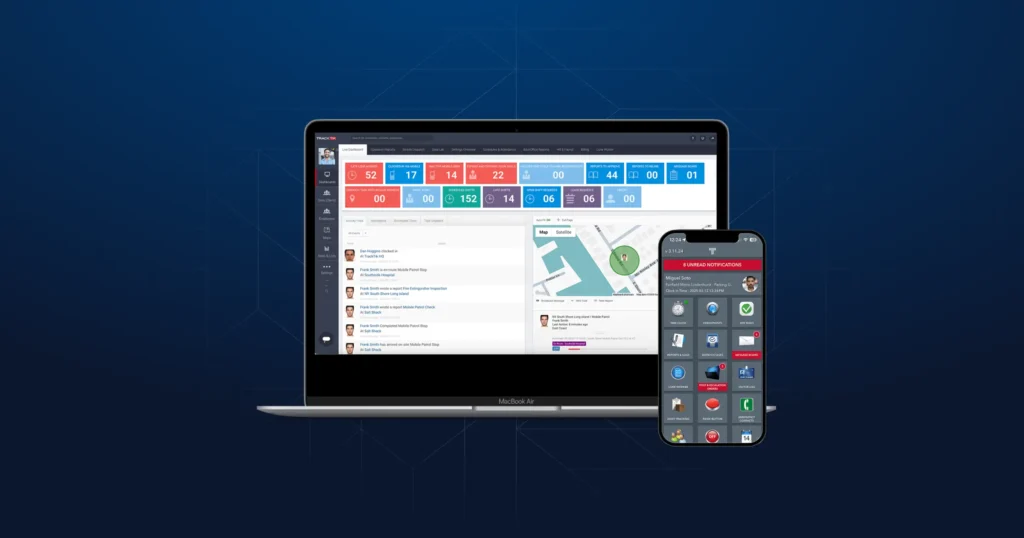
Client-facing portals in modern security platforms surface patrol data, checkpoint logs, incident reports, and SLA performance metrics without requiring a supervisor to compile them manually. Clients can view their account’s patrol history filtered by date, officer, shift, or location. Incident reports are accessible with their supporting evidence attached. SLA compliance is visible as a dashboard metric rather than a number in a monthly PDF.
The operational effect of this transparency is significant. Clients who can verify service delivery themselves have fewer reasons to escalate concerns to disputes. When questions do arise, the client portal provides the answer before a phone call is made. And for security companies, the portal serves as a continuous proof of value: every patrol completed, every checkpoint scanned, every incident documented is visible evidence of the service being delivered.
Proactive Reporting: Showing Value Before It Is Questioned
Automated patrol summaries, scheduled to arrive in a client’s inbox daily or weekly, shift the accountability conversation from reactive to proactive. Rather than waiting for a client to question whether patrols occurred, security companies can make patrol completion a standing agenda item with documented evidence attached.
TrackTik’s reporting module generates client-ready patrol reports broken down by account, officer, checkpoint, date, and regional office. These reports require no manual preparation. The data is collected automatically during patrol activity and presented in a format designed for client review, not just internal operations.
The Real-Time Visibility Problem: Scenarios That Break Trust
Three operational scenarios consistently generate accountability disputes. Each one is addressable with the right platform:
The dispatcher who cannot efficiently assign officers without knowing their locations.
When a call comes in and dispatch has to reach guards by radio to determine who is closest and available, response times extend and assignments are made on incomplete information. A live GPS map view showing all officer locations in real time allows the dispatcher to assign the nearest available guard immediately, with documented response time from assignment to on-site.
The manager trying to confirm patrols were completed without real-time data.
Without live patrol tracking, a supervisor confirming whether a route was completed must wait for end-of-shift logs, pull CCTV footage, or take the guard’s word. An active patrol view showing each stop in the sequence as completed or pending gives supervisors the ability to intervene before an SLA breach occurs, not after.
Walk-offs and unauthorized post abandonment.
A guard who leaves their post mid-shift creates a security gap and a liability. Geofencing with automated departure alerts notifies supervisors the moment an officer leaves a defined operational boundary during an active shift, allowing immediate response rather than post-incident discovery.
The Information Flow Test: Evaluating Software for Guard Accountability
Before evaluating any accountability technology, run this test against your current operations. The answers tell you where your exposure sits.
|
Question |
With Modern Verification |
Without It |
|---|---|---|
|
How many steps between field activity and management visibility? |
1 step: activity is visible in real time on the supervisor dashboard. |
3+ steps: guard writes a log, supervisor collects it, manager reviews it hours later. |
|
How do you verify compliance with post orders? |
Digital confirmation at each checkpoint with timestamp and GPS coordinates. |
You ask the guard. Or check the paper log. If it was missed, you may never know. |
|
Can you confirm an incident report was filed within minutes of an event? |
The timestamp is embedded automatically when the report is created in the field. |
Reports are filed at end of shift. Minutes become hours. Details fade. |
|
Do you know where all your guards are right now? |
Live GPS map view shows every officer location in real time. |
Last known location is from their most recent radio check-in. |
What Documentation Stands Up in Legal Disputes?
When an accountability dispute moves from a client conversation to a formal proceeding, whether that is arbitration, litigation, or an insurance claim, the evidentiary standard changes. Understanding what documentation is legally defensible shapes how security companies should configure their accountability tech stack.
The Legal Defensibility Checklist
The following elements, when present in a documented record, significantly strengthen a security company’s position in formal disputes:
- Tamper-evident audit logs. Records that are stored in a platform with immutable logging cannot be backdated or altered after the fact. The system records when the entry was created, not just the time the guard entered. Look for platforms that log the creation timestamp and device identifier separately from the event timestamp.
- Chain of custody for incident evidence. Photos, videos, and written reports attached to an incident in the platform should carry embedded metadata linking them to the specific officer, device, location, and time. Evidence that can be traced from field capture to platform storage to export without modification is significantly more defensible than files that changed hands outside the system.
- Contemporaneous documentation. The closer in time a report is filed to the event it describes, the more weight it carries. Platforms that require guards to file reports in the field, with automatic timestamps, produce contemporaneous records. End-of-shift summaries do not.
- GPS coordinates on all activity. Officer location at the time of each recorded activity should be logged automatically, not self-reported. This prevents disputes about whether an officer was actually where they claimed to be when they filed a report.
- Post order compliance documentation. If a client’s site has specific procedural requirements and an incident occurs, the ability to show that officers received, acknowledged, and were compliant with those post orders is often determinative. Digital delivery with read-confirmation provides this.
- Complete patrol records, including exceptions. A record that shows every completed checkpoint is useful. A record that also shows every exception, every missed checkpoint, and every supervisor acknowledgment of that exception is more credible, because it demonstrates the system is capturing reality rather than presenting a curated picture.
How TrackTik Supports Legal and Compliance Documentation
TrackTik’s platform stores all patrol activity, checkpoint scans, incident reports, and officer location data in an auditable, exportable format. Incident reports support photo, video, and audio attachment with embedded GPS and timestamp metadata. ReportPro AI assists guards in producing accurate, detailed incident documentation in the field, reducing the quality variance that comes from self-directed reporting under pressure.
For compliance-sensitive environments, the platform’s role-based access controls allow security companies to configure exactly who can view, edit, or export sensitive incident records, with all access activity logged. This supports chain-of-custody integrity from the point of field capture through management review to client reporting.
Beyond Dispute Resolution: Using Accountability Data Strategically
Accountability data collected for compliance purposes is also operational intelligence. Security companies that treat their patrol and incident records only as a defensive asset leave significant value on the table.
Performance Reviews and Coaching
Checkpoint scan rates, patrol completion percentages, incident report quality, and response times are all quantifiable metrics derived from accountability data. Supervisors who have access to this data by officer can conduct evidence-based performance reviews and identify specific areas for coaching. An officer with a pattern of late checkpoint scans at a specific site may need additional training on that location. An officer with consistently high incident report quality is a candidate for leadership development.
This level of specificity is only possible when the accountability system is capturing granular data by officer and route rather than just aggregate compliance rates.
Client Retention and Proactive Value Demonstration
The security companies most vulnerable to contract loss are those whose clients have no regular visibility into service delivery and must take quality on faith. The security companies most resistant to client churn are those who make their patrol data a regular part of the client relationship.
Monthly or quarterly business reviews anchored in documented patrol completion rates, response times, and incident trend data reframe the relationship from vendor-to-client to partner-to-partner. A client who has seen consistent, documented evidence of service delivery over 12 months is far harder to dislodge by a competitor’s pitch than a client who is operating on assumption.
Pricing Justification for Premium Services
Accountability data is also a pricing argument. A security company that can demonstrate sub-five-minute average response times, 99 percent checkpoint completion rates, and zero missed patrol windows is delivering a measurably different product from one that cannot produce those numbers. This is the foundation for a premium pricing tier that clients can evaluate against concrete evidence rather than sales claims.
The data already exists in the platform. Surfacing it strategically, in client conversations, contract renewals, and proposal documents, converts an operational asset into a revenue-protection and growth tool.
The Accountability Standard Has Changed
Clients who accepted monthly PDF summaries and verbal assurances five years ago increasingly expect real-time visibility, documented compliance, and evidence-based reporting as baseline requirements. The security companies that meet this standard are not just resolving disputes more effectively; they are building client relationships that do not generate disputes in the first place.
TrackTik’s platform is built around this accountability standard, from GPS-verified patrol activity and multi-method checkpoint scanning to real-time client portals and AI-assisted incident documentation. The result is a complete evidence layer that protects security companies when disputes arise and demonstrates value proactively before they do.
The question is no longer whether accountability technology is worth the investment. It is whether the cost of operating without it, in disputes resolved, contracts lost, and trust eroded, is something your business can afford.
Frequently Asked Questions
Featured Articles
Insights and advice from Spear faculty and industry experts