

How to Evaluate a Mobile Field Coordination Platform for Physical Security
Post on
March 16, 2026 •
By
TrackTik
What Is a Mobile Field Coordination Platform in Physical Security?
Physical security operations are, by nature, distributed. Guards cover multiple sites. Mobile patrol officers move between accounts across a city. Dispatch teams respond to incidents without knowing exactly where their nearest available officer stands. The coordinator trying to manage all of this from a central operations desk has historically relied on radio calls, manual run sheets, and a lot of hoping for the best.
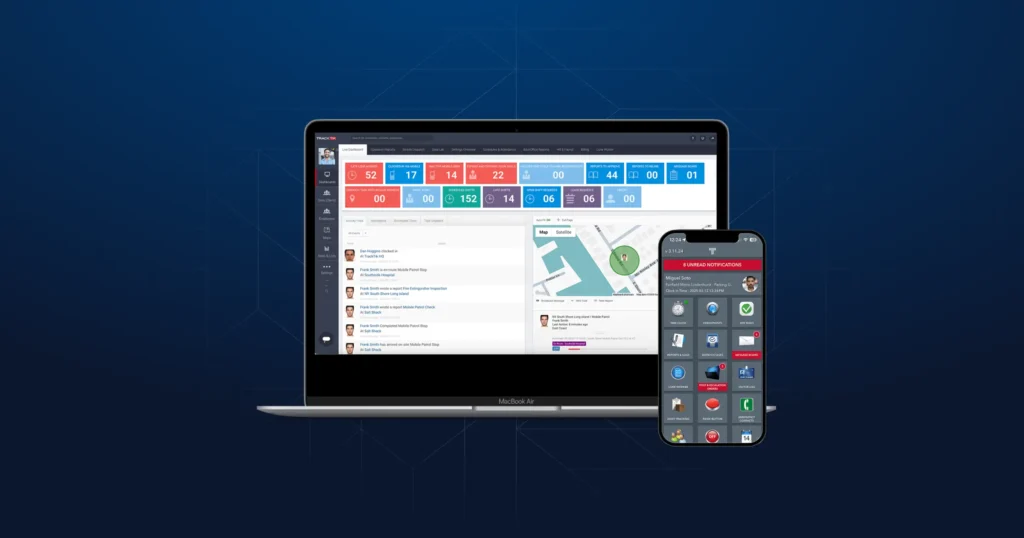
A mobile field coordination platform changes that dynamic fundamentally. In the context of physical security, it is purpose-built software that centralizes patrol scheduling, route management, real-time officer tracking, dispatch, incident reporting, and client communication into a single operational environment: accessible from both a command desk and a guard’s mobile device in the field.
This is a distinct category from generic field service software. A plumber’s scheduling app and a security patrol platform may share surface-level similarities, but the operational requirements diverge quickly. Physical security demands unpredictability as a feature, not a bug: patrol routes that are efficient but not predictable enough to be exploited. It requires chain-of-custody documentation, not just work order completion. It requires proof-of-presence at checkpoints, not just timestamps. And it must perform reliably when guards are in parking structures, remote sites, or areas with degraded connectivity.
Industries including utilities, construction, and facilities management also rely on mobile workforce coordination tools. But for physical security providers and enterprise security teams, the requirements are specific enough that purpose-built platforms consistently outperform general-purpose field service software in the capabilities that matter most: patrol verification, incident documentation, SLA compliance, and client transparency.
Core Capabilities That Define Effective Mobile Patrol Coordination
The gap between a basic guard tracking app and a mature mobile field coordination platform is significant. The following capabilities distinguish platforms designed specifically for security operations from tools that treat security as an afterthought.
Real-time GPS tracking and live operational visibility. Supervisors and dispatch teams need to know where officers are at all times, not where they were five minutes ago. GPS-driven map views showing officer locations in real time allow dispatchers to assign the nearest available guard to an emerging incident and give operations managers a live picture of whether patrols are progressing on schedule. Geofencing extends this capability by establishing site boundaries, restricted zones, and check-in perimeters that trigger automated alerts when officers enter or leave defined areas.
Route optimization with configurable unpredictability. Mobile patrol effectiveness depends on two competing requirements: efficiency and unpredictability. Optimized routes reduce travel time between accounts and help officers meet their patrol schedules. Randomized or variable route sequencing prevents patterns that would allow a site to be cased. Mature platforms handle both simultaneously, providing the fastest route between stops while allowing supervisors to configure the patrol order variably across shifts. Grace periods can be built into patrol schedules to account for variables like traffic or extended client interactions without triggering false exceptions.
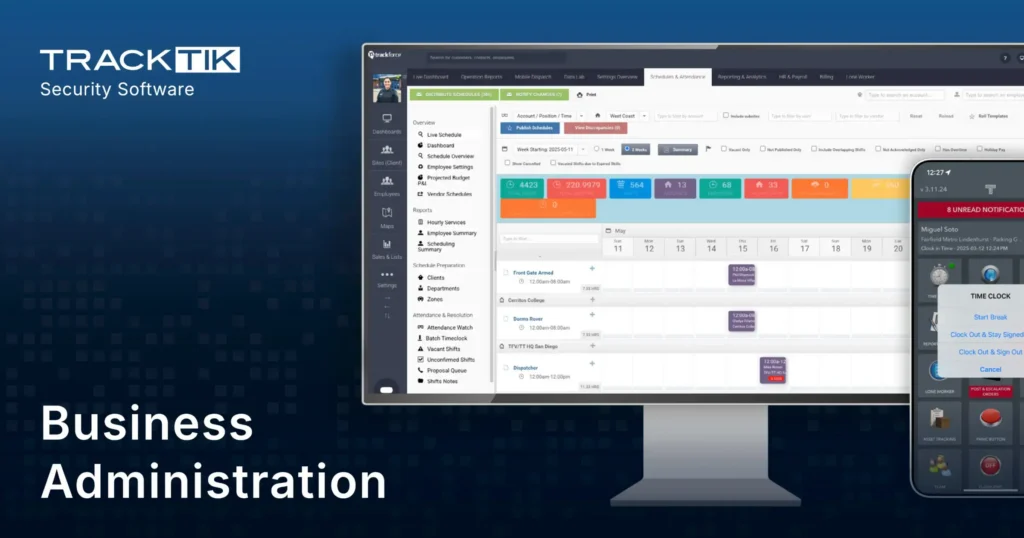
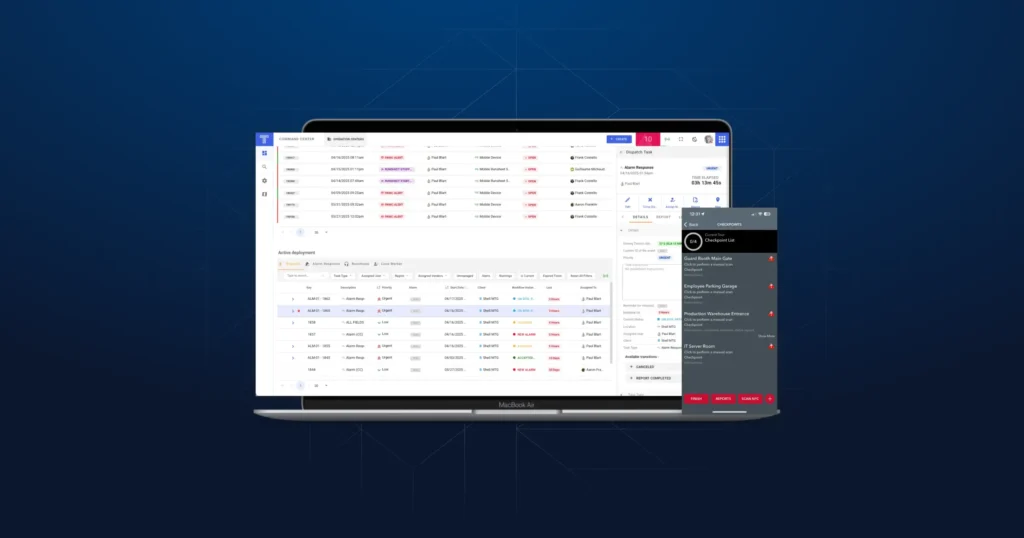
Active patrol view and run sheet management. Dispatchers and supervisors need more than a map. They need a real-time view of where each patrol stands in its sequence of tasks, which stops have been completed, which are pending, and whether any exceptions have been flagged. Active patrol views and run sheet tracking provide this operational layer, allowing supervisors to intervene, reassign jobs, or amend schedules dynamically without breaking contractual obligations.
Guard tour checkpoint verification. Proof of presence is a core deliverable in physical security. Officers should be verifiable at specific locations at specific times using GPS coordinates, NFC tags, QR codes, or barcodes placed at checkpoints. Each scan creates a timestamped, location-stamped audit trail that can be used for contract compliance verification, client reporting, and investigation support. Exceptions: missed checkpoints, late arrivals, or out-of-sequence scans: are flagged automatically for supervisor review.
Incident reporting with multimedia evidence capture. An incident report filed in the field should be more than a text entry. Modern mobile patrol platforms allow guards to attach photos, videos, and audio recordings directly to incident reports, with GPS coordinates, timestamps, and metadata embedded automatically. Standardized report templates with customizable fields, incident categories, and severity classifications ensure consistency across a distributed workforce and reduce the burden on individual officers to structure their own narratives. AI-assisted reporting tools, such as TrackTik’s ReportPro AI, further reduce friction by helping guards write accurate, complete reports faster.
Offline capability. Cell coverage is not guaranteed across every patrol route. Parking structures, basements, remote industrial sites, and rural properties all present connectivity challenges. A mobile patrol platform that fails without internet access is a liability. Platforms designed for field operations allow guards to continue logging patrols, scanning checkpoints, and capturing incident data offline, with automatic synchronization when connectivity is restored.
Dispatch and job management. Mobile patrol coordinators regularly deal with unexpected events: alarm responses, medical calls, client requests, and officer availability changes. Dispatch functionality allows supervisors to create new jobs, assign them to officers based on proximity and availability, and track their status in real time. The ability to handle unscheduled events without disrupting the rest of the patrol schedule is a critical operational requirement that generic scheduling tools rarely accommodate well.
Automated, client-ready reporting. The data collected during patrols has value beyond internal oversight. Clients expect transparency into how their sites are being protected. Platforms that generate detailed, customizable patrol reports broken down by route position, account, patrol status, officer, date, and regional office allow security companies to demonstrate service delivery clearly and defend their SLA compliance with concrete evidence.
Why Physical Security Requires Purpose-Built Mobile Coordination
Generic mobile workforce management tools are often evaluated for security operations and found wanting in ways that only become apparent during implementation. Several characteristics of physical security work drive the need for platforms designed specifically for the domain.
Patrol unpredictability is a security requirement, not just a scheduling preference. In most field service industries, route optimization means the same efficient sequence every time. In physical security, a predictable patrol is a compromised patrol. A platform that cannot randomize stop sequences while still providing efficient routing between them cannot satisfy this fundamental requirement.
Proof of presence is contractually and legally significant. A security company’s ability to demonstrate that an officer was at a specific location at a specific time is not just an operational concern; it is a contractual, liability, and potentially legal matter. GPS coordinates and checkpoint scan logs that are tamper-evident and exportable for audits are a non-negotiable capability.
Incident documentation feeds compliance, investigations, and client relationships. When an incident occurs on a client’s property, the quality of documentation affects insurance claims, legal proceedings, client retention, and regulatory compliance. A platform that treats incident reporting as a simple text form is inadequate for these stakes. Multimedia capture, structured categorization, severity escalation workflows, and role-based access to sensitive reports are all required elements.
High staff turnover demands rapid onboarding. Guard turnover in the security industry routinely exceeds 100 percent annually. A mobile platform that requires extensive training before guards can use it effectively imposes a continuous operational cost. Platforms designed with a simple, intuitive guard-facing interface reduce onboarding time and the error rate among newer officers.
Client transparency is a competitive differentiator. Security companies that can provide clients with real-time or near-real-time visibility into patrol activity, incident reports, and SLA performance through a client-facing portal hold a meaningful advantage over those delivering monthly PDF summaries. The data already exists in the platform; surfacing it for clients requires the right architecture.
Key Benefits and Measurable Outcomes
The business case for investing in a purpose-built mobile patrol platform is supported by documented operational improvements across multiple dimensions.
Organizations deploying advanced mobile workforce management tools report operational efficiency gains of up to 30 percent. Schneider Electric documented a 20 percent reduction in operational costs and a 25 percent improvement in first-time resolution rates following deployment of mobile knowledge tools for field teams. In the security context, first-time resolution translates directly to incident containment and client confidence.
For security companies, the financial benefits extend beyond operational efficiency. Accurate billing verification, enabled by GPS-confirmed hours and checkpoint logs, reduces billing disputes and revenue leakage. Automated invoicing connected to time and activity data shortens invoice cycles and reduces administrative overhead. Client-facing reporting reduces the time supervisors spend on manual account management.
For enterprise security teams, the value centers on compliance, documentation quality, and the ability to demonstrate service delivery to internal stakeholders. Audit-ready logs, structured incident archives, and automated exception alerts reduce risk exposure and strengthen the case for security investment during budget cycles.
Integration with Enterprise Systems
A mobile patrol platform that operates as an isolated system limits its own value. The data generated by patrol activity, officer hours, incidents, and site tasks becomes significantly more useful when it flows into the enterprise systems that govern scheduling, payroll, compliance, and business intelligence.
System connectivity, in this context, refers to a platform’s ability to securely share, synchronize, and process data across multiple operational and administrative systems, eliminating manual re-entry, accelerating data flow, and removing the silos that slow response and decision-making.
Practical integration points for physical security platforms include:
- Scheduling and payroll systems, where confirmed patrol hours and shift data flow automatically into payroll calculations, reducing manual timesheet reconciliation and the errors associated with it.
- HR systems, where officer onboarding, certifications, and termination data are synchronized to ensure that only credentialed, currently employed officers are active in the platform.
- Accounting systems, where billable hours and service delivery data feed directly into invoicing workflows. SIEM and security information platforms, where incident data can be ingested for broader security analytics and SOC integration.
- Client-facing portals and reporting systems, where patrol logs and incident summaries are surfaced automatically.
TrackTik’s open API architecture supports connections to business-critical applications across all of these categories, allowing security operations to function as an integrated part of a larger enterprise stack rather than a siloed operational system.
Evaluating a Mobile Field Coordination Platform: What to Look For
Organizations evaluating platforms for physical security mobile patrol coordination should approach the process with requirements specific to the domain, not generic field service checklists.
The following criteria are most diagnostic of a platform’s fitness for physical security operations:
Why TrackTik for Mobile Field Coordination
TrackTik’s Mobile Suite was built specifically to address the operational realities of physical security: the need for routes that are both efficient and unpredictable, the requirement to verify officer presence at contractually defined checkpoints, and the expectation that incident documentation holds up under legal and compliance scrutiny.
TrackTik’s Mobile Patrol module gives supervisors complete control over patrol routes, allowing them to optimize for efficiency while building in unpredictability to ensure reliable service delivery. Configurable grace periods account for shift variables without triggering false exceptions, and the active patrol view provides a live feed of mobile operations so resources can be reassigned and run sheets amended without breaking contractual obligations to clients or officers.
Checkpoint verification runs across GPS, NFC, QR codes, and barcodes, with exceptions flagged instantly and contract compliance always verifiable. Incident capture and escalation are handled in real time from the field through standardized, customizable forms supported by ReportPro AI, which helps guards write faster and more accurate reports.
When connectivity is unavailable, TrackTik continues to function offline and syncs automatically when connection is restored. Checkpoint verification methods including NFC tags and QR codes remain available as backup options, ensuring that no patrol activity is lost regardless of network conditions.
On the reporting side, patrol data can be broken down by route position, account, patrol status, user, date, job type, run sheet, and regional office Tracktik, giving operations managers and clients a granular view of service delivery without manual report preparation.
TrackTik supports security operations in over 50 countries with multilingual support across 55+ languages, and connects to business-critical applications through an open API Tracktik, including payroll, HR, accounting, and SIEM platforms. The result is a platform that functions as an integrated part of an enterprise stack rather than a standalone operational tool.
For organizations ready to move beyond generic field service software and invest in a platform designed for the specific demands of physical security, TrackTik offers a free demo at tracktik.com.
Frequently Asked Questions
Featured Articles
Insights and advice from Spear faculty and industry experts